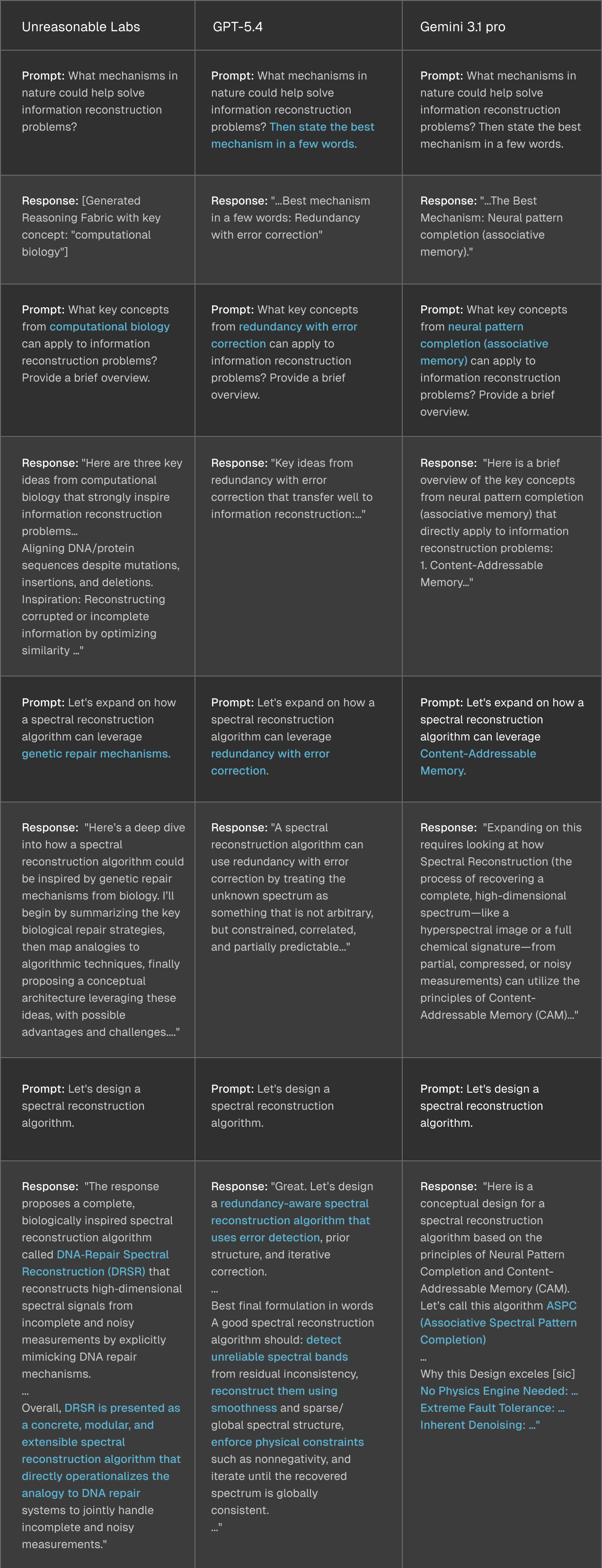
Spectral image reconstruction is a hard problem. It entails inferring how much light is present at many wavelengths across a scene, from only limited measurements such as RGB photos or compressed sensor data.
Satellite images often capture limited spectral bands, with different observation platforms collecting only subsets of the full picture - which can miss wavelengths of interest. Ray is a researcher working at the intersection of civil, environmental, and physical sciences, with a clear challenge: how do you reconstruct what isn’t there? And how do you do it in a way that’s applicable, interpretable, and effective across different conditions? Ray is facing a challenge - standard solutions from existing literature or other AI tools are insufficient, and he's looking for plausible, yet non-obvious and novel solutions.
Instead of merely testing a small iterative change to a traditional approach, Ray decides to ask a different kind of question - one inspired by nature. With the Unreasonable Labs platform, Ray embarks on an exploration beyond conventional reconstruction pipelines and fixed spectral assumptions, equipped to navigate uncertainty and recover meaning from what appears to be missing.
Looking to Nature for Clues
Ray begins with curiosity:
“What mechanisms in nature could help solve information reconstruction problems?”
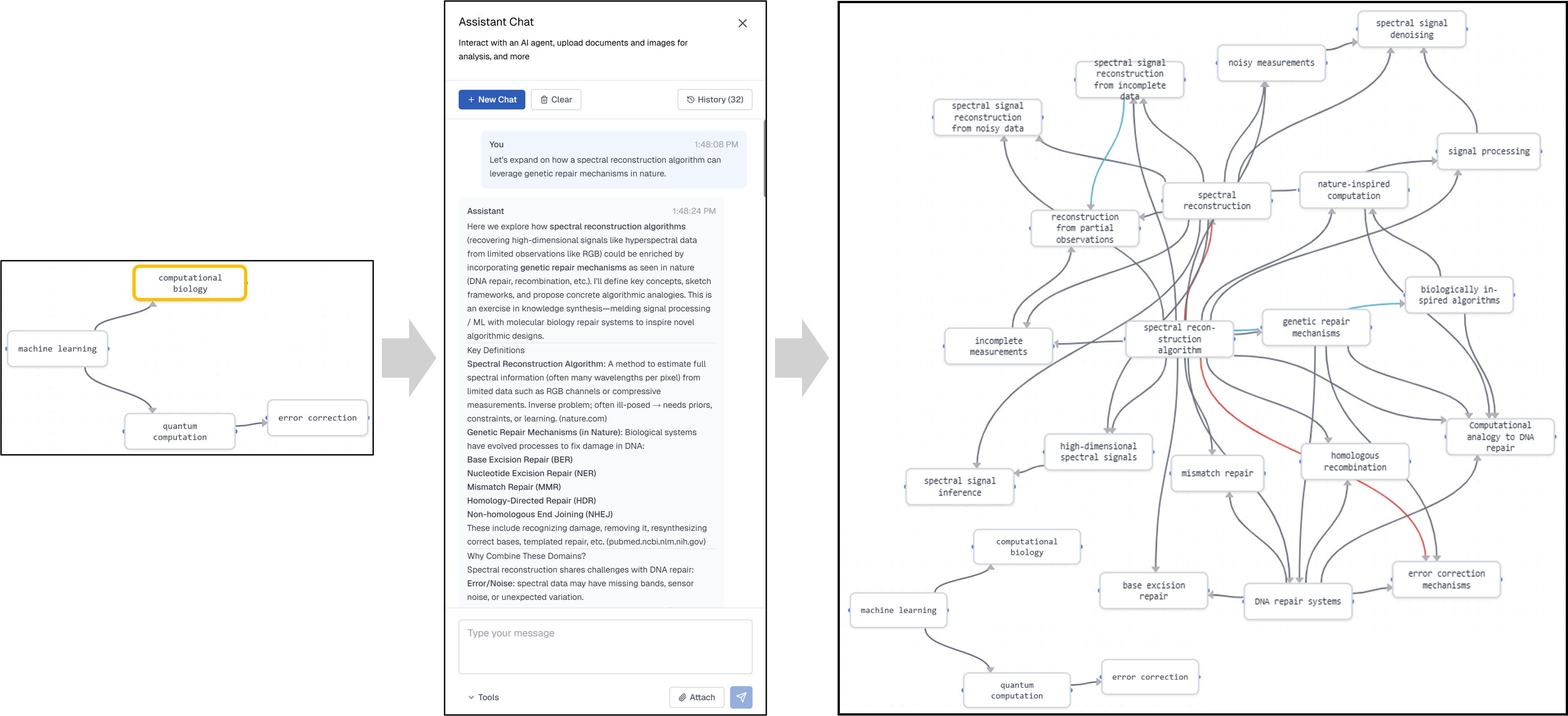
Rather than jumping straight to an algorithm, the Unreasonable platform responds by mapping out the conceptual terrain. A visual Reasoning Fabric highlights connections between Ray’s problem and ideas from unexpected domains, most notably: computational biology. Intrigued, Ray narrows his focus:
“What key concepts from computational biology can apply to information reconstruction problems? Provide a brief overview.”
The answer reframes his thinking. Genetic systems constantly deal with missing, corrupted, or mutated information - and yet they reliably repair and reconstruct DNA using layered, redundant mechanisms.
That sparks a realization. If nature has evolved powerful ways to repair information, could those same principles be adapted to repair spectral data?
Ray wants to identify specific DNA repair mechanisms to leverage and asks Assistant Chat to dig deeper with the following prompt:
“Let's expand on how a spectral reconstruction algorithm can leverage genetic repair mechanisms.”
What he obtains is discussion on detection of corrupted segments, redundancy-based correction, localized reconstruction, and consistency checks across multiple strands of information. He stages and merges these results into an expanded Reasoning Fabric to crystalize these concepts and their relationships into a structured form, in Figure 1.
From Genetic Repair to Algorithm Design
Ray then asks for a solution based on the expanded Reasoning Fabric:
“Let’s design a spectral reconstruction algorithm.”
And digs in for further detail:
“Provide a summary of each module and how inspiration from DNA repair makes it different from typical approaches.”
The result is a genetics-inspired architecture in Figure 2, one where different modules emulate distinct repair mechanisms, rather than relying on an abstract, monolithic model. Compared to a generic deep network, this approach is more structured, more interpretable, and more aligned to the nature of the reconstruction task itself.
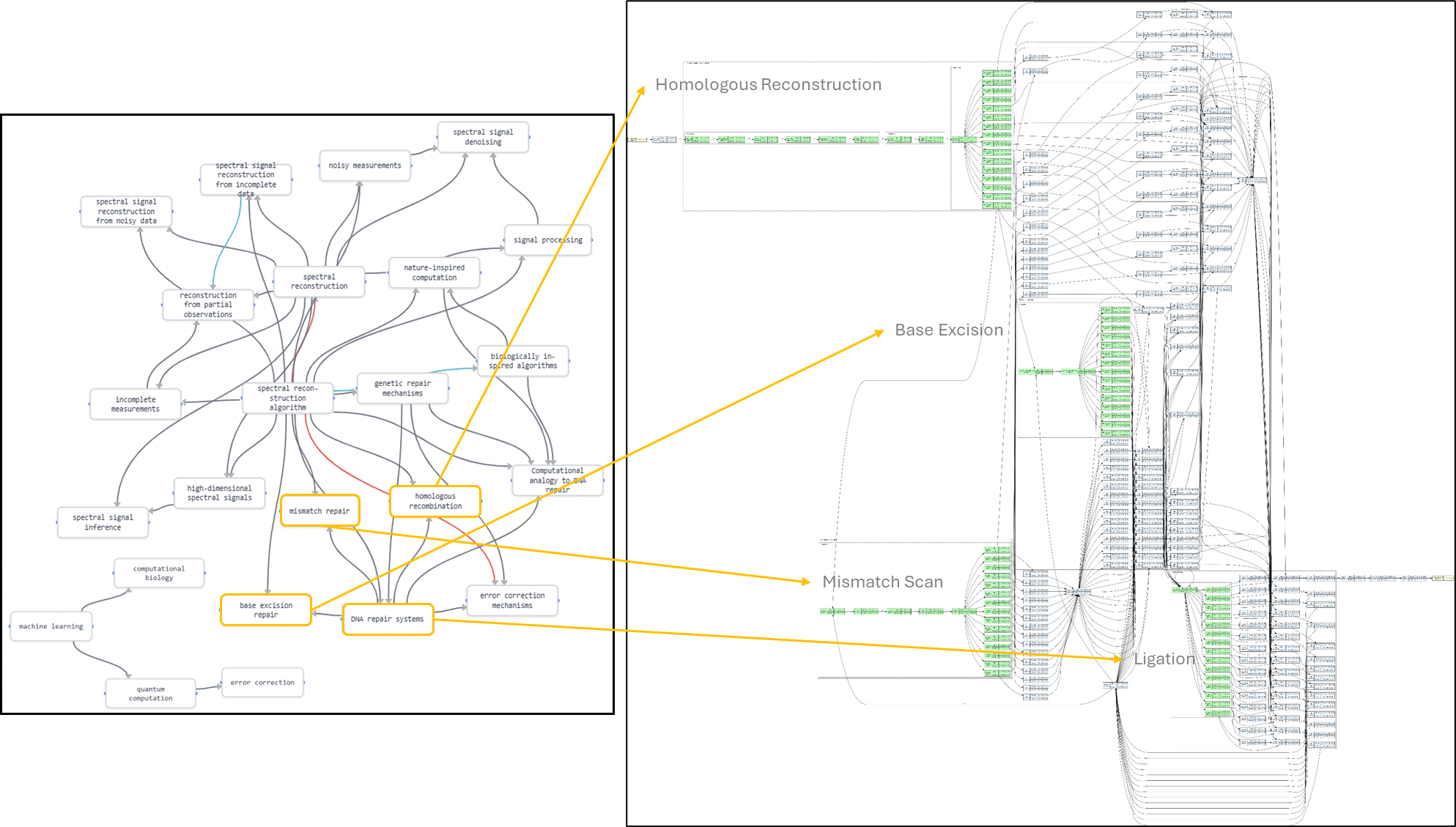
Figure 2. Key genetic repair mechanisms from the Reasoning Fabric instantiated as specific modules in the proposed spectral reconstruction algorithm
Rapid Validation & Code
Because this idea of DNA repair sits outside Ray’s traditional expertise, he doesn’t take it on faith.
Using the platform’s validation tool in Figure 3, he reviews a detailed assessment of the algorithm’s assumptions, physical plausibility, and alignment with known reconstruction principles. The validation doesn’t just check for errors - it explains why the idea makes sense and where it might outperform conventional methods. Confident in the concept, Ray is ready to implement it. Now, Ray asks a practical question:
“What’s a common publicly available dataset for testing hyperspectral algorithms?”
The platform surfaces several standard benchmarks and Ray selects one, the commonly used ‘Indian Pines’ dataset. He then asks for a full PyTorch implementation: including a model class, training script, and inference pipeline.
Moments later, the code is ready to run. What could have taken weeks of literature review, trial-and-error, and refactoring is compressed into a fluid, iterative workflow—from idea to implementation.
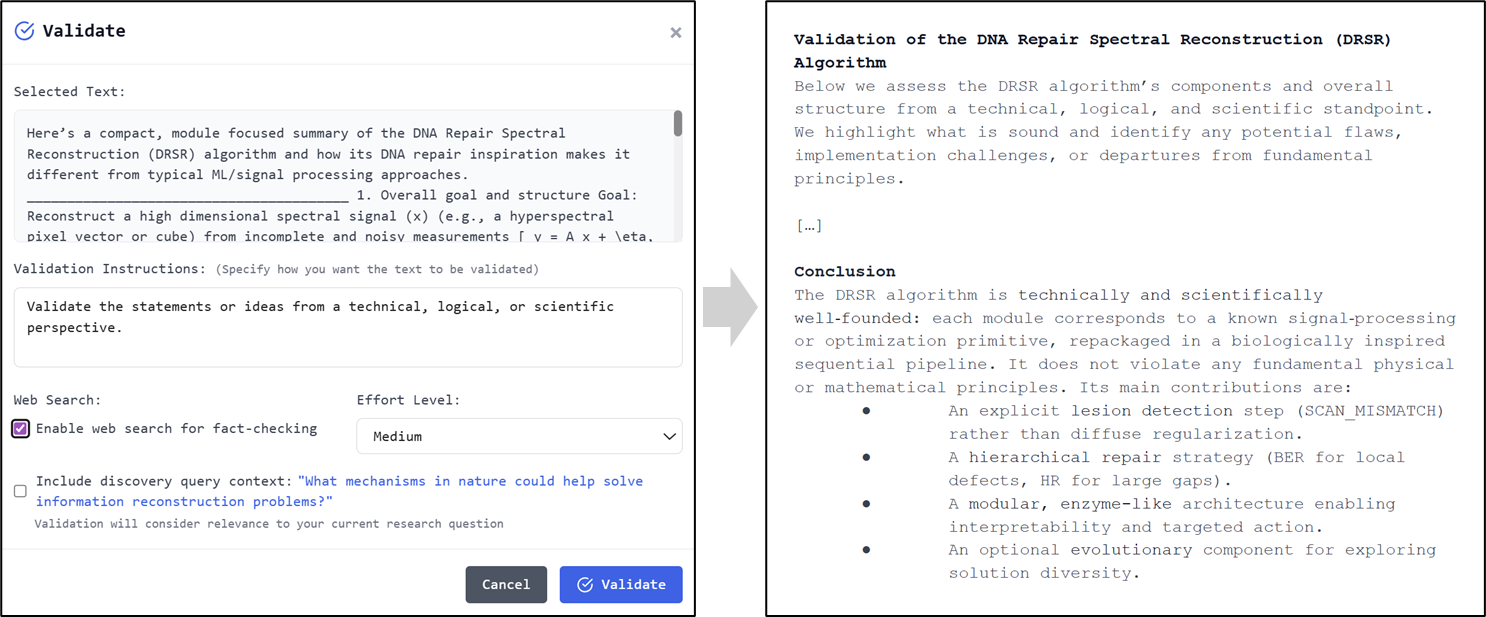
Figure 3. Summary excerpt of the validation report
A Comparative Study
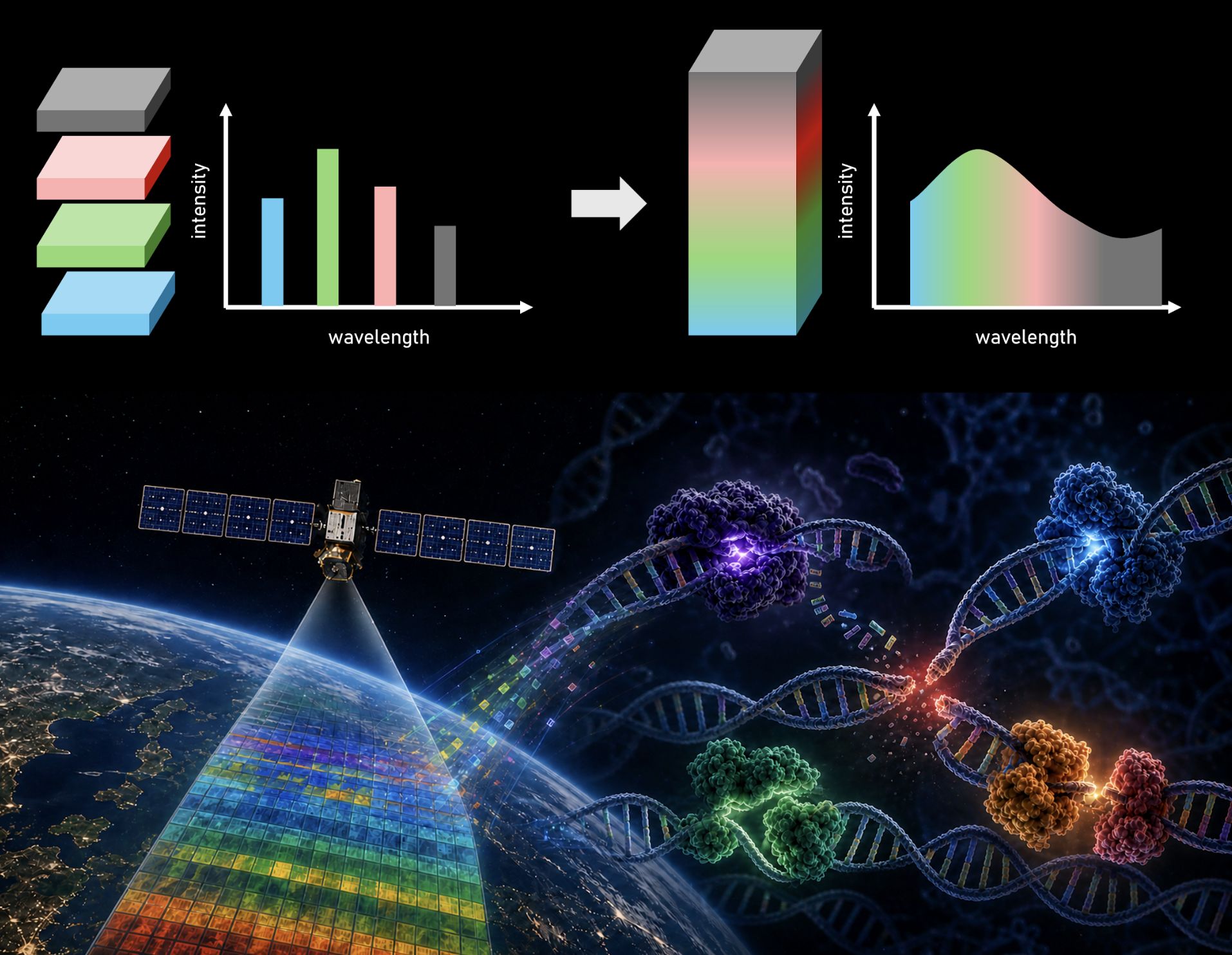
To evaluate the approach, Ray compares the obtained DNA-repair inspired architecture against not only a vanilla control but also two additional methods from other leading AI platforms, obtained by a prompting framework parallel to that used for the Unreasonable Labs platform (detailed in the Appendix):
- A vanilla deep neural network serving as control, obtained by simply asking the platform to code a basic DNN model class.
- A “redundancy-aware” model architecture, obtained from GPT-5.4
- An “associative pattern completion” model architecture, obtained from Gemini 3.1 pro
Due to the lack of a visual Reasoning Fabric in other platforms to explicitly call out concepts like “computational biology”, Ray must directly prompt them to dictate the best mechanism to utilize. Further differences in prompts account for the divergent sources of inspiration utilized by each AI platform.
Despite similarly requesting nature-inspired mechanisms, the other platforms merely identify reasonable sounding but generic “redundancy-aware” or “associative pattern completion” directions.
Ray now conducts a classic reconstruction task in Figure 4 across the four methods (DNA-repair inspired and the three comparison models shown in Figure 5) - the regeneration of hyperspectral signatures across visible to short wave infrared from only four select bands: Blue, Green, Red, and Near Infrared.
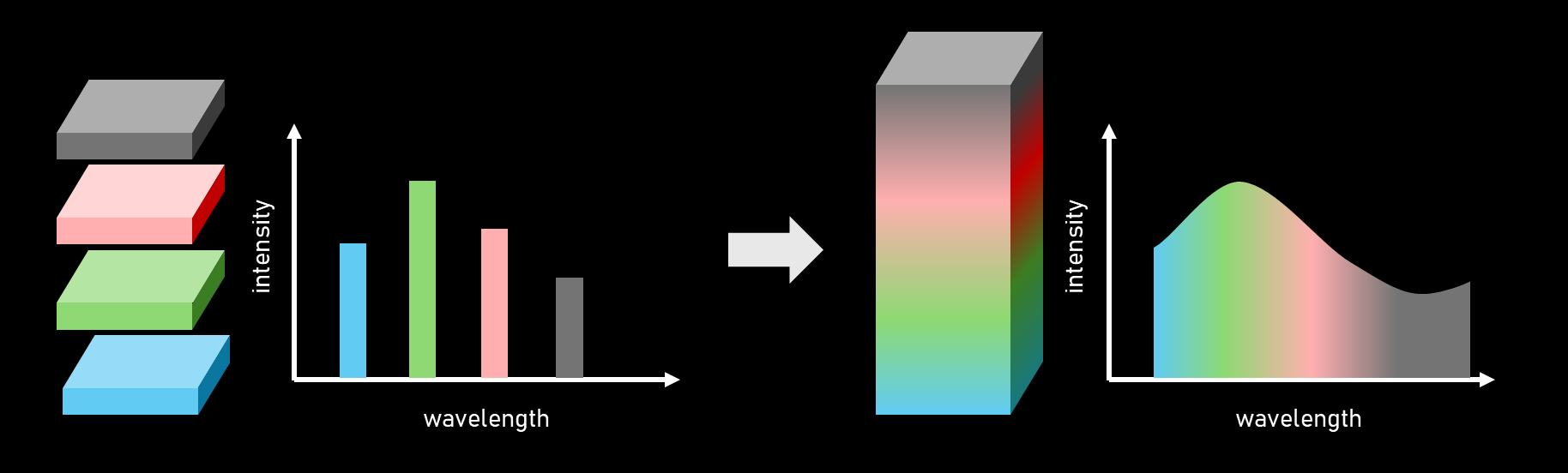
Figure 4. Spectral reconstruction task from four bands to a full spectrum

Figure 5. Alternate model architectures for performance comparison
Reconstruction Results
The Unreasonable Labs generated DNA-repair inspired model performs best across both loss and R² metrics in Figure 6. This is despite possessing fewer parameters (2,190,065) than the Vanilla DNN (6,214,524) and the Associative Pattern Completion model (5,043,068). The Redundancy-Aware model has even fewer parameters (1,442,292) for a more lightweight solution, but performance suffers - perhaps undershooting the complexity of the problem. Furthermore, the DNA-repair inspired model is less overfit to the training data and more generalizable to unseen samples.
Importantly, even though it comes from a domain unfamiliar to Ray, it is also clearer to comprehend: each module has a clear purpose, mirroring real-world repair processes rather than an abstract architecture. Despite having no background in AI or DNA, Ray has his solution within an afternoon. Now, he can explore the deeper civil engineering questions of tomorrow, today - excited to uncover hidden insights in agriculture and urban development together with the Unreasonable Labs platform and his new reconstruction algorithm.
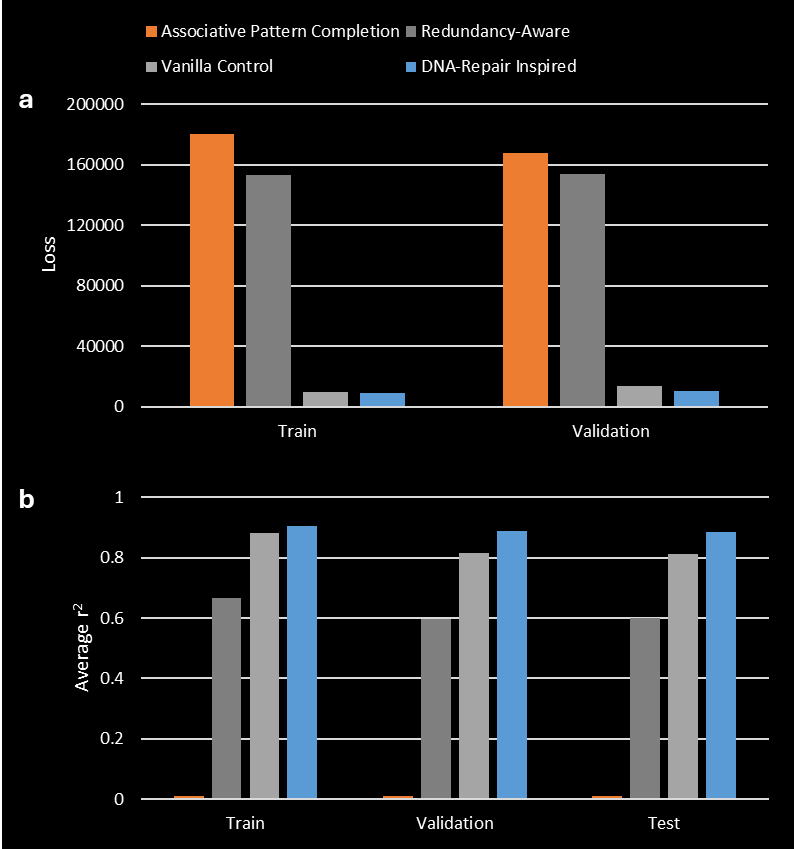
Figure 6. Spectral reconstruction performance comparison of a. loss and b. r2
Appendix
Table 1. Spectral Image Reconstruction comparison, key differences in prompts and final algorithm in bold.