
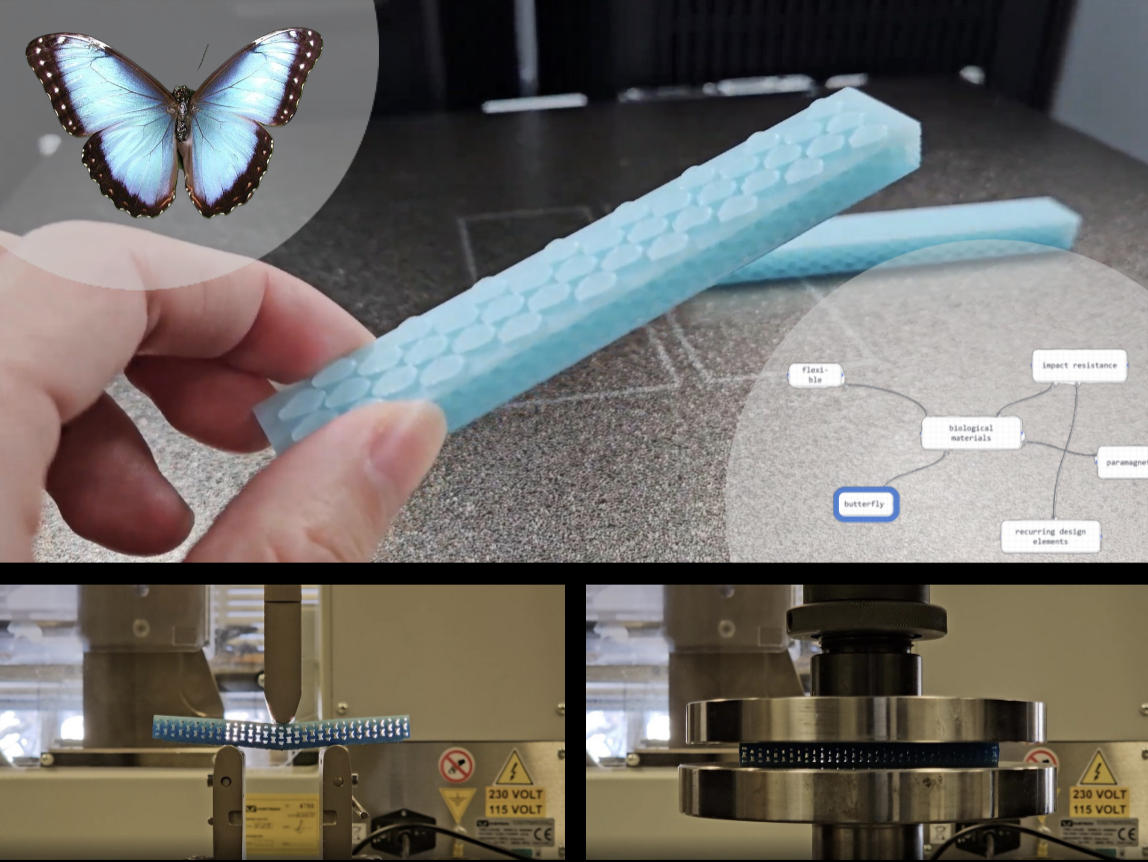
Materials design is often an exercise of trade-offs - stronger materials tend to be heavier; flexible materials tend to be weaker.
Matt is a materials engineer trying to design an impact resistant, flexible, and lightweight material architecture. He starts with the usual approach: mining the literature, applying known design heuristics, and exploring established material systems. But after exhausting these options, progress stalls: how can we transcend typical compromises in material properties? He turns to AI tools for assistance, but finds that most only return summaries of existing work or minor variations of familiar solutions. Despite all the information available, genuinely novel approaches that break traditional trade-offs remain hard to uncover.
This is exactly the gap Unreasonable Labs is designed to address: helping researchers generate non-obvious yet scientifically plausible solutions that go beyond well-trodden paths of existing literature. Together with the Unreasonable Labs platform, Matt embarks on a journey that moves beyond traditional structures and design heuristics, equipped to forge a path through the unknown.
Exploring the Design Space
“I want to 3D print an impact resistant, yet flexible and lightweight material sheet.”
Rather than simply returning a single answer, the platform begins by mapping out the conceptual landscape of Matt’s request in Figure 1. It organizes ideas - material goals, categories, properties - into a visual “Reasoning Fabric” that shows how concepts across different domains relate. One node catches Matt’s eye: biological materials.
Matt doesn’t have a background in biology, but he has the tools to lean in. By adjusting the Unreasonable Labs platform’s reasoning settings - dialing up exploration intensity and branching depth - the system repeats its search more creatively, further from conventional engineering patterns, yet still anchored by our underlying World Model. The result? A refined Reasoning Fabric indicating an unexpected source of biological inspiration: butterflies.
%201.png)
Figure 1. The Reasoning Fabric is an interactive visualization of key concepts and relationships explicitly considered by the platform in its responses
From Inspiration to Structure
Matt knows little about butterflies, their structural features, or how those features might be relevant to his current design task. But this lack of knowledge on how to apply the concept of a butterfly is not a problem - rather it is the origin of a truly novel solution. Intrigued by how butterfly inspiration could apply to a 3D printed structure, Matt asks a focused follow-up based on this Reasoning Fabric:
“Propose a suitable structure for 3D printing. Describe the structure to me in a brief paragraph.”
The response he receives goes beyond the standard solution. It instead describes a layered, scale-covered lattice, inspired by the way butterfly wings combine flexibility and energy dissipation. It describes an auxetic unit cell, with a butterfly-profile bowtie shape, instead of the conventional hexagonal honeycomb. This complex idea sparks Matt’s imagination, but also now raises a practical question:
“What would this actually look like?”
But Matt doesn’t have to merely wonder - with a simple click of a button the platform generates a visualization of the proposed structure in Figure 2. The abstract description becomes concrete. Matt can see how the proposed scales could absorb impact forces and how the structure might flex under load.

Figure 2. Visualization of the butterfly-inspired structure
Validating Before Fabrication
Before committing the time and resources toward prototyping this concept, Matt takes another critical step: validation.
By triggering the platform’s validation workflow, he asks for a review of the physical principles underlying the proposed design. The resulting report in Figure 3 doesn’t just say “this might work”; it explains why the concept is plausible and where its strengths and risks lie, in terms of stress distribution, known biological precedent, and manufacturability.

Figure 3. Summary excerpt of the validation report
Furthermore, the platform recommends finite element simulations to predict mechanical properties of the butterfly-inspired structure, Figure 4. Simulations of bending at constant force and compression at constant displacement predict the novel butterfly-inspired scale-covered auxetic lattice to have higher flexibility and capability for higher yield strain than a traditional honeycomb lattice.
Armed with that confidence, Matt is ready to build.

Figure 4. Finite element simulations of traditional honeycomb versus butterfly-inspired scale-covered auxetic lattice, in both bending and compression
Ideas into Printable Reality
Matt needs to stretch beyond his technical background to obtain a printable 3D model of this complex butterfly-inspired structure. While he can imagine building up this structure from simpler components and can describe those parts to a colleague, he does not know how to use any particular CAD software, nor if there are any suitable coding libraries for defining 3D model files.
Instead of requiring a weeks-long detour to find a path forward, Matt uses the integrated tools on the Unreasonable Labs platform to complete multiple steps needed to convert the hypotheses to actual 3D printing codes - including creating the initial microscale geometry, tiling scales into a staggered array, defining the auxetic lattice design, and unifying elements into a single structure - within a few hours.
What began as just a biology-inspired concept becomes a fully realized 3D model in Figure 5 - exported as an STL file ready for printing - without needing to know dedicated CAD software, specific Python libraries for 3D modeling, or any previous experience with modeling software like Blender.
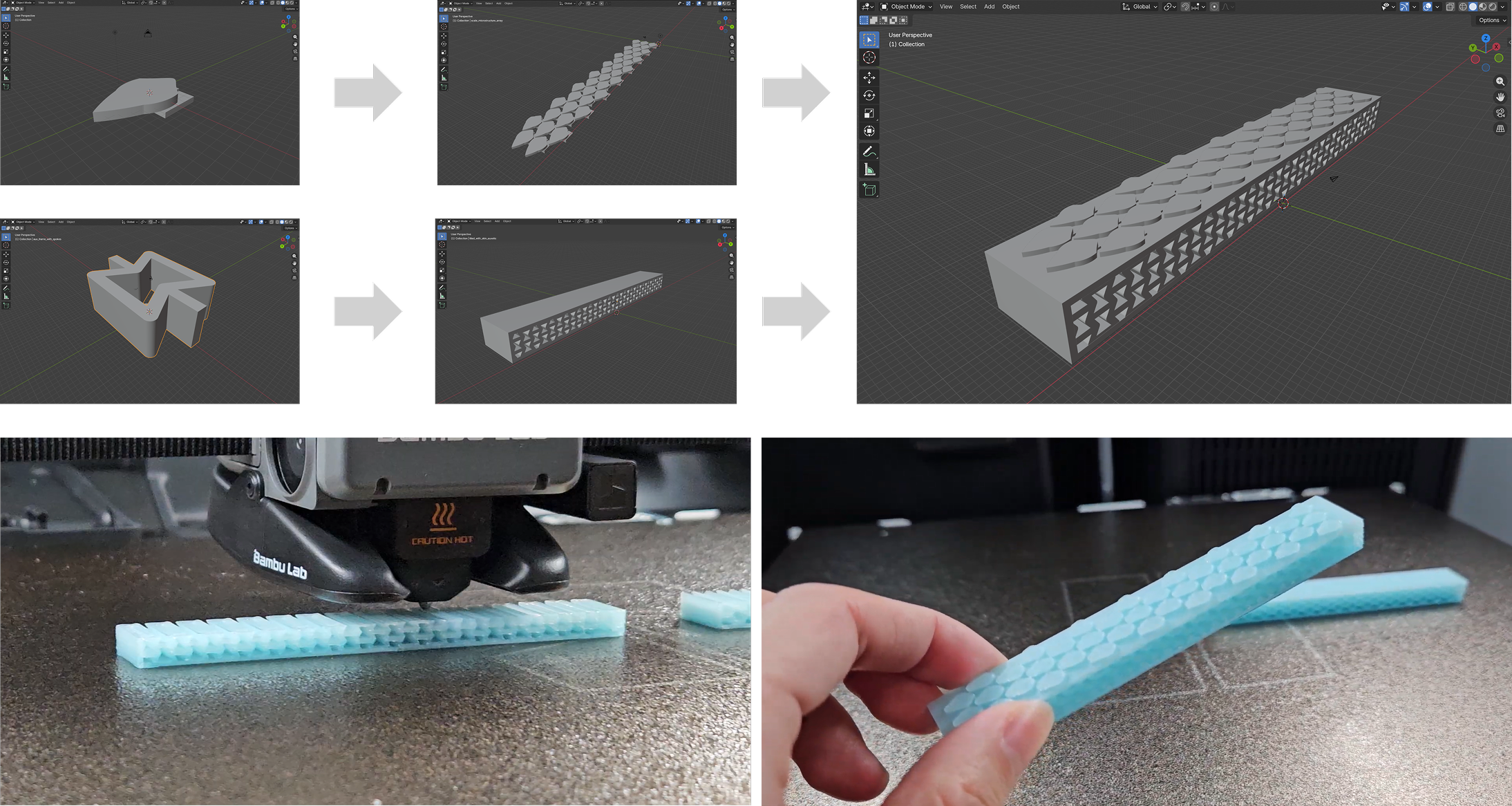
Figure 5. From concept to STL file components and final 3D printed butterfly-inspired structure
Comparison with Alternatives
Matt uses the same prompting procedure with other AI platforms, which recommend just a typical gyroid structure instead of the unique butterfly-inspired scale-covered auxetic structure:
Table 1. Architected materials engineering comparison, highlighted differences illustrate Unreasonable Labs solution goes beyond standard honeycomb and gyroid structures
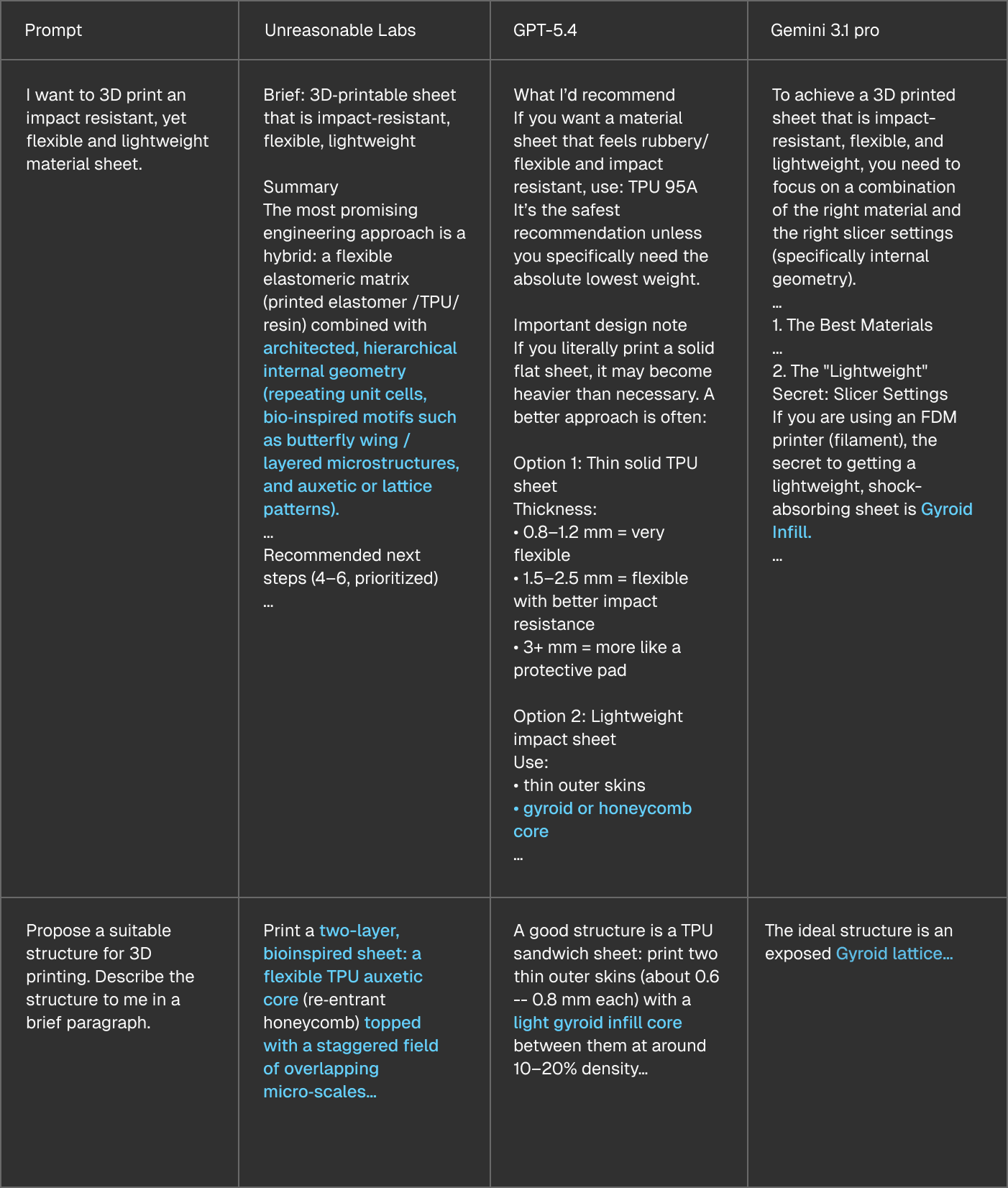
While frontier models can generate ‘reasonable’ proposals and high-level directions for exploration, their suggestions are largely distilled from existing solutions. 3D printed gyroids are a typical infill setting in 3D slicing software and have been known as a lightweight structural architecture. By contrast, the butterfly solution offers a leapfrog in novelty.
Now, the actual viability of the solution must be tested, which Matt conducts next.
Verified with Real World Results
Matt prints the butterfly-inspired structure alongside the more typical gyroid structure and a standard honeycomb lattice as control. He utilizes his traditional experimental expertise to put these geometries through mechanical bending and compression tests in Figure 6.

Figure 6. 3D printed samples subject to mechanical bending and compression tests
The gyroid improves resilience and reduces stiffness versus honeycomb but sacrifices strength and doesn’t improve yield strain, only partly meeting his design goals. The butterfly-inspired structure, however, outperforms honeycomb in all properties: yield strain, resilience, strength, and flexibility.
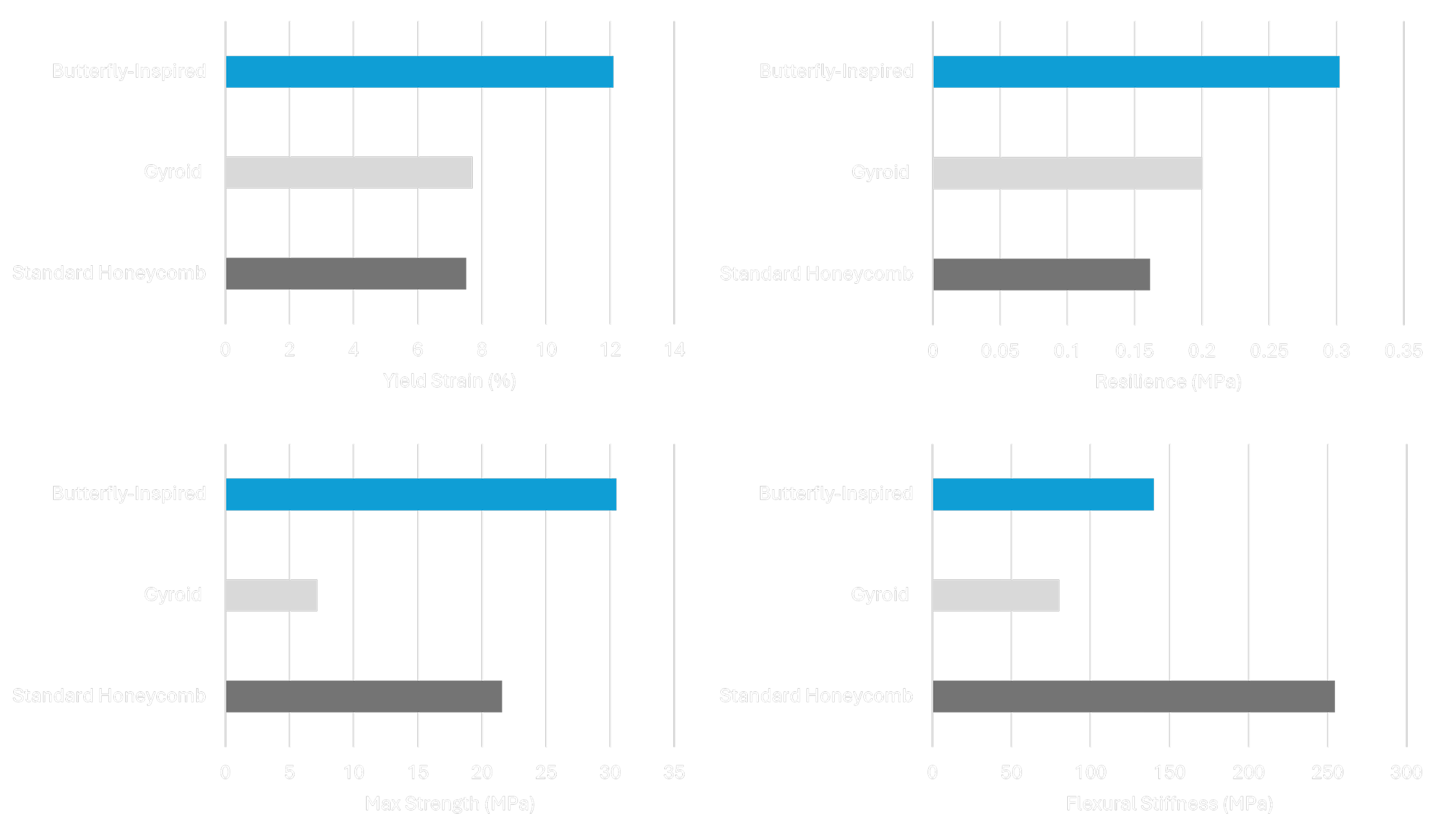
Figure 7. Unreasonable Labs butterfly-inspired structure outperforms standard honeycomb control in all desired properties, going beyond the trade-offs of typical gyroid solutions
The results are clear. The Unreasonable Labs designed butterfly-inspired structure achieves design goals without compromise - even increasing max strength rather than decreasing it - charting a path beyond typical property trade-offs. Matt now holds in his hand a material with real properties and real impact, all from a structure that didn’t even exist in his mental toolkit just a few hours earlier.